

HIRAS – Hiiltä sitovat rakennusmateriaalit suomalaisista sivuvirroista
Carbon-sequestering building materials from Finnish side streams
What is HIRAS?
HIRAS is a three-year project jointly conducted by four independent research organization -Aalto University, Geological Survey of Finland GTK, Savonia University of Applied Sciences and Oulu University. The project answers the national call for green transition under the theme Carbon-neutral circular economy society.
Building Our Future from Finland’s Side Streams
HIRAS aims at developing low emission cementitious construction materials leveraging existing Finnish side streams next to three major Municipalities of Helsinki, Oulu and Kuopio. The work aims lowering the CO2 emissions of construction materials used for infrastructure development in Finland by at least half than existing levels. The consortium has recently been able to develop carbon negative cementitious materials using high volume side streams in the construction sector such as excavated soil and biochar from organic side stream. The developed technology lowers emissions even up to net zero levels by storing CO2 in construction materials as precipitated solid carbonates utilizing biochar as a catalyst. The consortium aims at utilizing local organic side streams (mostly biochar), inorganic tailing materials and earthwork waste (clays, slags, etc.) to come up with unique local low carbon cementitious materials for infrastructure development.
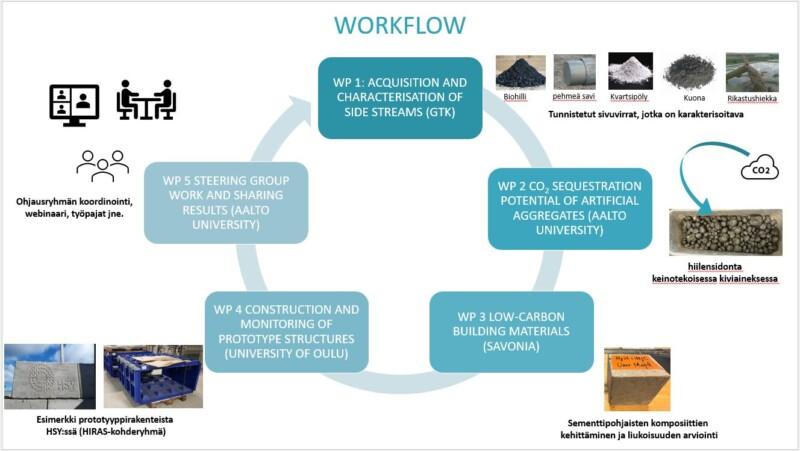
The project contain 5 work packages.
Finnish side streams
We begin with locally sourced materials: Excavated earth, clay surplus, mine tailings and biochar from organic and wood waste
Innovative carbonation process
The excavated waste clay is mixed with tailing material and binder, where biochar acts as catalyst.
Durability of the new material
The new recipes are used to construct pilot walls in three Municipalities of Helsinki , Oulu and Kuopio to monitor the effects of Finland’s demanding climate on the durability of the newly made composites.

Biochar as a carbon sink
Through the pyrolysis processing of organic waste such as wood-based side stream, a solid by-product is developed termed as biochar (BC) or ‘biohilli’ in Finnish. BC is identified as a carbon negative material having tunable properties such as high specific surface area, high pH, hydrophilicity, CO2 adsorption potential, and high porosity. Biochar is found to be excellent material to develop low emission cementitious composites as reported by the consortiums recent work in Hanafi et al. (2024).
Members and collaborators